
CAM La Porta, MC Lionetti, S Bonfanti, S Milan, C Ferrario, … Proceedings of the National Academy of Sciences 116 (38), 18777-18782 (2019)
Science
1st Toffee Workshop on disinformation
TOFFEe – https://toffee.imtlucca.it/ – is an interdisciplinary research project funded by IMT School For Advanced Studies Lucca. The project ambition is to overcome some of the limitations of existing social platforms, which often dedicate little attention to trustworthy interactions among peers and to reliability of information. The aim of the project is to increase people’s confidence on the data they get and who they follow, while minimising the risk of exposure to fake information and malicious actions.
As part of the dissemination activities of the project, on October 24th and 25th, 2019, we organise an International Workshop where different approaches for fighting fakes will be discussed. You can find all infos at https://toffee.imtlucca.it/ We are glad to invite you to the 1st TOFFEe workshop and contribute with your latest results on methodologies for fighting disinformation.We would be delighted if you could join us. The registration to the workshop is free, just fill the form following the link
https://toffee.imtlucca.it/. We kindly ask you to register before the 9th of October. The registration comprehends two coffee breaks and one lunch.
Analogously, we would be delighted if you could contribute to the workshop with your latest results. The slot for the contributions last nearly 15 minutes, plus some time for questions. You can send us a 2 pages abstract at the present email address. The deadline for sending the abstract is on the 25th of September. We will return our decision on the 2nd of October.
Looking forward to meeting you in Lucca in October, we send you our
best regards,
Rocco De Nicola (project coordinator)
Guido Caldarelli
Irene Crimaldi
Marinella Petrocchi
Fabio Saracco
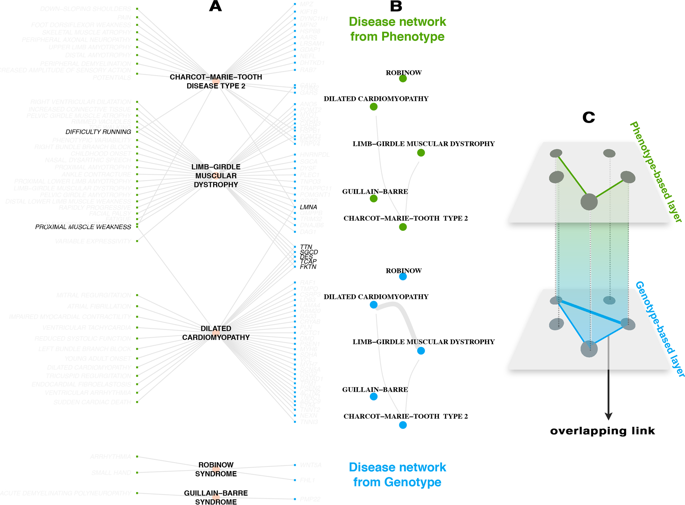
The multiplex network of human diseases
Arda Halu, Manlio De Domenico, Alex Arenas and Amitabh Sharma
npj Systems Biology and Applications 5, 15 (2019)
DOI: 10.1038/s41540-019-0092-5
Untangling the complex interplay between phenotype and genotype is crucial to the effective characterization and subtyping of diseases. Here we build and analyze the multiplex network of 779 human diseases, which consists of a genotype-based layer and a phenotype-based layer. We show that diseases with common genetic constituents tend to share symptoms, and uncover how phenotype information helps boost genotype information. Moreover, we offer a flexible classification of diseases that considers their molecular underpinnings alongside their clinical manifestations. We detect cohesive groups of diseases that have high intra-group similarity at both the molecular and the phenotypic level. Inspecting these disease communities, we demonstrate the underlying pathways that connect diseases mechanistically. We observe monogenic disorders grouped together with complex diseases for which they increase the risk factor. We propose potentially new disease associations that arise as a unique feature of the information flow within and across the two layers.
The fragility of decentralised trustless socio-technical systems
Manlio De Domenico and Andrea Baronchelli
EPJ Data Science 8, 2 (2019)
DOI: 10.1140/epjds/s13688-018-0180-6
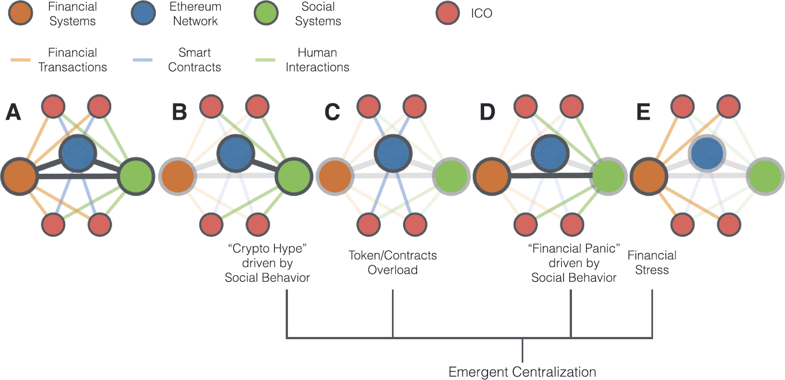
The blockchain technology promises to transform finance, money and even governments. However, analyses of blockchain applicability and robustness typically focus on isolated systems whose actors contribute mainly by running the consensus algorithm. Here, we highlight the importance of considering trustless platforms within the broader ecosystem that includes social and communication networks. As an example, we analyse the flash-crash observed on 21st June 2017 in the Ethereum platform and show that a major phenomenon of social coordination led to a catastrophic cascade of events across several interconnected systems. We propose the concept of “emergent centralisation” to describe situations where a single system becomes critically important for the functioning of the whole ecosystem, and argue that such situations are likely to become more and more frequent in interconnected socio-technical systems. We anticipate that the systemic approach we propose will have implications for future assessments of trustless systems and call for the attention of policy-makers on the fragility of our interconnected and rapidly changing world.
Postdoc position @CoMuNe Lab in Trento
Q@TN is a joint initiative of the University of Trento, the Bruno Kessler Foundation, and the National Research Council aimed at coordinating their present and future activities in the field of Quantum Science and Technologies. Q@TN promotes research projects, technological transfer, education and training.
The project “ARTificial Intelligence for Quantum Systems” (ARTIQS) is inherently interdisciplinary, fostering cross-fertilization between the machine-learning and network-theory communities in ICT, the computational physics community and materials scientists in Trento, with a unique opportunity for the post-doctoral associate to work within and beyond the realm of quantum physics.
Official call: here
Technologist position @CoMuNe Lab in Trento
FBK invites applications for a technologist position in the area of Network Science. The candidate must have strong skills in learning and customizing algorithms for interactive analysis and visualization of networks, enriched data streams or static data (academic and industrial use cases will be considered).
Official call: here
Bots increase exposure to negative and inflammatory content in online social systems
Massimo Stella, Emilio Ferrara, and Manlio De Domenico
PNAS 115, 12435 (2018)
doi: 10.1073/pnas.1803470115
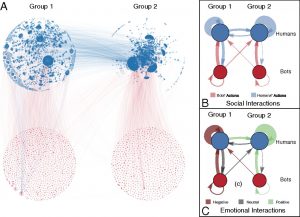
Societies are complex systems, which tend to polarize into subgroups of individuals with dramatically opposite perspectives. This phenomenon is reflected—and often amplified—in online social networks, where, however, humans are no longer the only players and coexist alongside with social bots—that is, software-controlled accounts. Analyzing large-scale social data collected during the Catalan referendum for independence on October 1, 2017, consisting of nearly 4 millions Twitter posts generated by almost 1 million users, we identify the two polarized groups of Independentists and Constitutionalists and quantify the structural and emotional roles played by social bots. We show that bots act from peripheral areas of the social system to target influential humans of both groups, bombarding Independentists with violent contents, increasing their exposure to negative and inflammatory narratives, and exacerbating social conflict online. Our findings stress the importance of developing countermeasures to unmask these forms of automated social manipulation.
Postdoctoral positions at the Center for Complexity and Biosystems
 We have two openings for postdoctoral positions to work in computationally intense interdisciplinary research at the CC&B, University of Milan. We are looking for candidates with strong programming skills who are interested in working at the frontier between academic and industrial research. The candidates should have a Ph. D in computer science, computational materials science, physics, mathematics or engineering. The positions will be for 1 year, renewable to a second one.
The theme of the first position is the development of algorithms for quantitative analysis of biological data, including images.
The second position is focused on the automatic design of metamaterials in the framework the METADISGN project funded by a Proof-of-Concept grant from the European Research Council.
Interested candidates should send their CV to: stefano.zapperi@unimi.it,caterina.laporta@unimi.it
Optimal positioning of storage systems in microgrids based on complex networks centrality measures
By Saman Korjani, Angelo Facchini, Mario Mureddu, Guido Caldarelli, Alfonso Damiano
Published in Scientific Reports (2018) 8:16658
 We propose a criterion based on complex networks centrality metrics to identify the optimal position of Energy Storage Systems in power networks. To this aim we study the relation between centrality metrics and voltage fluctuations in power grids in presence of high penetration of renewable energy sources and storage systems. For testing purposes we consider two prototypical IEEE networks and we compute the correlation between node centrality (namely Eigenvector, Closeness, Pagerank, Betweenness) and voltage fluctuations in presence of intermittent renewable energy generators and intermittent loads measured from domestic users. We show that the topological characteristics of the power networks are able to identify the optimal positioning of active and reactive power compensators (such as energy storage systems) used to reduce voltage fluctuations according to the common quality of service standards. Results show that, among the different metrics, eigenvector centrality shows a statistically significant exponential correlation with the reduction of voltage fluctuations. This finding confirms the technical know-how for which storage systems are heuristically positioned far from supply reactive nodes. This also represents an advantage both in terms of computational time, and in terms of planning of wide resilient networks, where a careful positioning of storage systems is needed, especially in a scenario of interconnected microgrids where intermittent distributed energy sources (such as wind or solar) are fully deployed.
Keeping global climate change within 1.5 ºC through net negative electric cities

By Chris Kennedy, Iain D Stewart, Michael I Westphal, Angelo Facchini, and Renata Mele, Current Opinon in Environmental sustainability, 2018, 30:18-25, https://doi.org/10.1016/j.cosust.2018.02.009
The development of net negative electric cities encompasses the three strategies of decarbonizing power supply, energy efficiency and electrification. There is potential to pursue these combined strategies rapidly to hold climate change to within 1.5 ºC. Recent work has identified many cities in developing countries that are ideal for electrification today based on carbon intensity and high access to electricity. Net negative electric cities could be achieved by following a comprehensive policy framework for low carbon investment.