• Skip to primary navigation
  • Skip to main content
  • Skip to primary sidebar
  • Home
  • About
  • Research
  • Conference
    • CCS/Italy 2019
    • CCS/Italy 2023
  • Jobs
  • Events
  • Members
    • Labs
    • Executive Board
    • Local Coordinators
    • All
  • Contact

CSS/Italy

Italian Chapter of Complex Systems Society

Science

November 11, 2018 research

A Statistical Approach for Modeling the Aging Effects in Li-Ion Energy Storage Systems

By Mario Mureddu, Angelo Facchini, Alfonso Damiano

Published in IEEE Access, vol 6, 2018, 42196


 This paper presents a novel approach for the technical and economic assessment of Li-ion battery energy storage systems (BESS) in smart grids supported by renewable energy sources. The approachis based on the denition of a statistical battery degradation cost model (SBDCM), able to estimate the expected costs related to BESS aging, according to the statistical properties of its expected cycling patterns.

This new approach can improve the assessment of the economical sustainability of BESSs in this kind of applications, helping in this way the planning processes in electricity infrastructures in presence of high penetration of intermittent renewable energy sources. The SBDCM proposed in this paper is a statistical generalisation of a battery degradation model presented in the literature. The proposed approach has been validated numerically comparing the results with those of the deterministic model considering for the BESS a stochastic dataset of input signals. In order to test the usefulness of the proposed model in a real world application, the proposed SBDCM has been applied to the evaluation of the economic benefit associated to the development of distributed energy storage system scenarios in the Italian power system, aimed to provide ancillary services for supporting electricity market.

November 11, 2018 research

Changes to Gate Closure and its impact on wholesale electricity prices: The case of the UK

Angelo Facchini, Alessandro Rubino, Guido Caldarelli, Giuseppe di Liddo

Published in Energy Policy, 125 (2019) 110-121

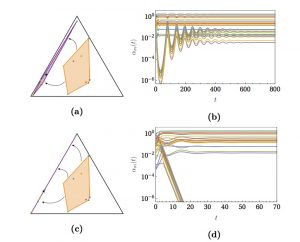
The electricity supply industry in the United Kingdom underwent a number of regulatory reforms since late 80’s that have transformed the trading and pricing of the energy market. Herein we provide empirical evidence that the Modification Proposal P12 (Mod P12) – that took place in 7/2/2002 – moving the Gate Closure (GC) interval from 3.5 h to 1 h before real time has caused a permanent alteration in the UK spot price volatility.

Using a combination of Recurrence Plot (RP) and Recurrence Quantification Analysis (RQA) we find that, after the the change in the GC time, short term price volatility significantly decreased between 2001 and 2008 while long term price volatility is not affected by CG change. Similar results are obtained by means of spectral analysis on the price series, showing a significant reduction in its variability. The results of our analysis suggest that a dynamical regime shift of the price occurred, and such shift is linked to the GC change whereby shorter GC intervals facilitate short-term forecasting on electricity demand and better reliability on the supply side. Therefore, GC closer to real time is associated to reduced price fluctuations in the wholesale market.
 

November 11, 2018 research

Portfolio analysis and geographical allocation of renewable sources: A stochastic approach

Antonio Scala, Angelo Facchini, Umberto Perna, Riccardo Basosi

Published in Energy Policy, 125 (2019), 154-159

We take inspiration from the Modern Portfolio Theory introduced by Markowitz to propose a simplified strategy for the portfolio management of renewable energy sources based on Gaussian fluctuations with tunable correlations.

By analysing the impact of production fluctuations, we show how – depending on the sources’ temporal correlation patterns – a careful geographical allocation of different types of renewal energy sources can reduce both the energy needs for balancing the power system and its uncertainty. The proposed strategy can be easilyintegrated in a decision support system for the planning of renewable energy sources. Therefore, providing  policy/decision makers with an additional tool. We test our strategy on a set of case studies including a real-case based on literature data for solar and wind sources, and discuss how to extend the computation to non-Gaussian sources.

The paper shows that in the Markowitz framework an efficient trade-off between production and  fluctuations can be easily achieved, and that such framework also leads to important considerations on energy security. In perspective, analysis of time series together with such enriched frameworks would allow for the analysis of multiple realistic renewable generation scenarios helping decisions on the optimal size and spatial allocation of future energy storage facilities.


October 23, 2018 jobs

PhD/PostDoc: Politecnico di Torino, Italy and New York University, USA

PhD/PostDoc: Politecnico di Torino, Italy and New York University, USA
Contributed by: Alessandro Rizzo, alessandro.rizzo@polito.it

I am writing to inform you that three positions are available within my research programs on complex and networked systems:

1) post-doctoral researcher, for a duration of 18 months, within the research project “Mac2Mic” – Macro to Micro: uncovering the hidden mechanisms driving network dynamics. The project is funded by the Italian Ministry of Foreign Affairs and International Cooperations and by the Ministry of Science and Technology of the State of Israel, in the framework of the bilateral initiatives of scientific and technological cooperation. The aim of the project is the inference of local/individual dynamics (node dynamics) in networked systems for which global measurements at the population level (i.e., “observables”) are available. The project is carried out in collaboration with Dr. Guido Caldarelli (Institute of Complex Systems, National Research Council, Rome, and IMT Lucca) and Dr. Baruch Barzel (Bar-Ilan University, Tel Aviv, Israel). The post-doctoral researcher will be hired at Politecnico di Torino. An outgoing mobility phase of at least two stays of two months each at Bar-Ilan University is mandatory (additional funds for mobility are allocated).

2) Ph.D. student at the New York University Tandon School of Engineering, Department of Mechanical and Aerospace Engineering, Dynamical Systems Laboratory, directed by Prof. Maurizio Porfiri. The research will be focused on time-varying complex networks for modeling and control of epidemic processes in heterogeneous populations. The candidate will enroll at New York University and will be co-mentored by Prof. Porfiri and myself. It will be possible to work toward a dual-title agreement with Politecnico di Torino, subject to a mobility activity of at least one year, which can be fractioned in two period of at least six months each.

3) Post-doc researcher at the New York University Tandon School of Engineering, Department of Mechanical and Aerospace Engineering, Dynamical Systems Laboratory, directed by Prof. Maurizio Porfiri. The research will be focused on time-varying complex networks for modeling and control of epidemic processes in heterogeneous populations. Duration and terms of the appointment are negotiable.

September 4, 2018 research

Adaptive metabolic strategies explain diauxic shifts and promote species coexistence

Authors: Leonardo Pacciani, Samir Suweis, Amos Maritan


Competitive systems are most commonly described mathematically using MacArthur’s consumer-resource model, leading to the “competitive exclusion principle” which limits the number of coexisting competing species to the number of available resources. Nevertheless, several empirical evidences – in particular bacterial community cultures – show that this principle is violated in real ecosystems. Another experimental evidence that cannot be explained in this framework is the existence of diauxic (or polyauxic) shifts in microbial growth curves: bacteria consume resources sequentially, using first the one that ensures the highest growth rate and then, after a lag phase, they start growing slower using the second one. By introducing adaptive metabolic strategies whose dynamics tends to maximize species’ relative fitness, we are able to explain both these empirical evidences, thus setting the paradigm for adaptive consumer-resource models.

July 24, 2018 events

13th SICC Workshop – Complexity and the City – Turin, Italy, October 29-30 2018

The workshop is the 13th of a series of tutorial workshops annually organized to explore the emergence of new research fields in which modeling, analysis and control of nonlinear and complex systems play a role of growing importance. These workshops have been traditionally devoted to an interdisciplinary audience with particular attention to PhD students and young researchers. The theme of this year is “Complexity and The City” with a unique focus on interactions, mobility, epidemics, information and misinformation spreading, and many other complex phenomena occurring in urban environments.

The workshop will gather scholars, students, and practitioners for two days of presentations and debates around complex systems science and its interplay with urban environments. A series of plenary lectures from renowned scholars is planned, while PhD students and young researchers will have dedicated sessions to present their research activity in an effective and appealing way. Social events will foster interaction and creation of collaboration opportunities. 

July 24, 2018 research

Ecology in financial markets

Our work on Long Term Ecology of Investors in a Financial Markets providing empirical evidence of the existence of an ecology of investors adapting their trading strategies over a long period of time is out on Palgrave Communications – Nature https://lnkd.in/evedBSs

July 5, 2018 jobs

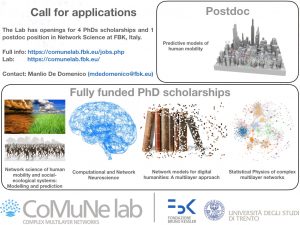
PhD and Postdoc positions at CoMuNe Lab

The Complex Multilayer Networks (CoMuNe) Lab is the Research Unit of Fondazione Bruno Kessler (FBK), placed in Povo (Trento, Italy), for modeling and analysis of complex and interconnected systems. Multilayer modeling often provides more insights than more traditional approaches, because they allow to naturally integrate available structural/relational/dynamical information. We use Network and Data Science to study structure, dynamics and resilience of real-world natural and artificial systems, from the human brain to society, at the edge of statistical physics, applied math and computer science.

We have 4 openings for fully funded PhD scholarships and 1 postdoctoral fellowship in Network Science (please, visit https://comunelab.fbk.eu/jobs.php for additional information):

– PhD #1
Deadline: Wed 22 Aug 2018 16:00 (Italian time)
Duration: 3 years
Where: FBK and Dept. of Mathematics
Title: Network models for digital humanities: A multilayer approach
Apply: Reserved Scholarship D, PhD Programme in Mathematics 34th cycle – Second Call 2018

– PhD #2
Deadline: Wed 22 Aug 2018 16:00 (Italian time)
Duration: 3 years
Where: FBK and Dept. of Mathematics
Title: Network science of human mobility: Modelling and prediction
Apply: Reserved Scholarship E, PhD Programme in Mathematics 34th cycle – Second Call 2018

– PhD #3
Deadline: Wed 30 Aug 2018 16:00 (Italian time)
Duration: 3 years
Where: FBK and Dept. of Physics
Title: Statistical Physics of complex multilayer networks
Apply: Reserved Scholarship M, PhD Programme in Physics 34th cycle

– PhD #4
Deadline: TBD (likely by the end of August)
Duration: 3 years
Where: FBK and Dept. of Information Engineering and Computer Science
Title: Computational and Network Neuroscience
Apply: TBD, send an email to Manlio De Domenico (mdedomenico@fbk.eu) and Stefano Merler (merler@fbk.eu) for more information

IMPORTANT: Please, be careful to apply explicitly for the corresponding reserved scholarship and that you satisfy the eligibility requirements. Reserved scholarships can only be assigned to those candidates who apply for and obtain the specific eligibility.
The PhD positions will start from 1st November 2018.

– Postdoc #1
Deadline: 31 July 2018 16:00 (Italian time)
Duration: 2 years
Where: FBK
Title: Network modeling of human mobility
Apply: Here

NOTE: Women and other underrepresented groups are strongly encouraged to apply to any available positions.

# Additional information

## About CoMuNe Lab

Natural and artificial networked systems exhibit a high level of complexity, such as simultaneous relationships or interactions, temporal variations, interdependency.

The Complex Multilayer Networks (CoMuNe) Lab (https://comunelab.fbk.eu/) is an interdisciplinary group at the Bruno Kessler Foundation (https://www.fbk.eu/en/) develops mathematical models to account for this high level of complexity of networked systems, using higher-order tensors to encode available information and to represent these integrated systems, called multilayer networks. Our areas of interest include

* Collective dynamics in complex socio-technical systems
* Human brain networks in neuro-degenerative diseases and psychiatric disorders
* Integration of multi-level/multilayer molecular networks in human diseases
* Social-ecological systems’ response to climate change
* Interplay between human mobility, information awareness and epidemics spreading
* Robustness and resilience of empirical complex systems

More information about the CoMuNe Lab is available at https://comunelab.fbk.eu/

Contact: Manlio De Domenico (mdedomenico@fbk.eu)

## About Bruno Kessler Foundation (FBK)

Top Research institute in Italy, ranked at the 1st place for scientific excellence within 3 different subject areas (ICT, History and Sociology) and for the economic and social impact according to the quality of research ANVUR evaluation for the period 2010-2014.

Fondazione Bruno Kessler is a research non-profit public interest entity.

Being the result of a history that is more than half a century old, through 2 scientific hubs, 7 research centers; 410 researchers; 100 PhD students from 25 countries; 220 between thesis-writing students, doctorate and post-doctorate students and visitng professors; 2 specialized libraries; 7 laboratories; FBK aims to results of excellence in science and technology with particular emphasis on interdisciplinary approaches and to the applicative dimension.

For more informaton, please visit: https://www.fbk.eu/en/ and https://www.fbk.eu/en/about-fbk/

June 15, 2018 jobs

Assegno di Ricerca at Observatory of Complex Systems – Palermo

Assegno di ricerca su “Development of metrics for the characterization of traffic flux on networks”. Deadline for application: 28 giugno 2018

Assegno di Ricerca Palermo

Bando

June 10, 2018 jobs

Open Ph.D positions in Computational Neuroscience in the Padova Neuroscience Center @University of Padova

Dear colleague,

call are open for Ph.D. position in Computational Neuroscience @ the Padova Neuroscience Center, University of Padova (http://pnc.unipd.it/phd-neuroscience/).

In particular we propose three different projects:

– The Critical Brain in Action (http://pnc.unipd.it/wp-content/uploads/2018/06/P19_Suweis.pdf)

– Controllability and Observability of Rat Brain Activity (http://pnc.unipd.it/wp-content/uploads/2018/06/P17_Vassanelli.pdf)

– Intrinsic brain activity and sensory coding in the rodent whisker somatosensory system (http://pnc.unipd.it/wp-content/uploads/2018/06/P18_Vassanelli.pdf)

The deadline for the application is 26 June 2018. 

Interested candidate can contact me: suweis@pd.infn.it

Please forward this message to potential interested collaborators and students.

Thanks

  • « Go to Previous Page
  • Go to page 1
  • Go to page 2
  • Go to page 3
  • Go to page 4
  • Go to page 5
  • Interim pages omitted …
  • Go to page 7
  • Go to Next Page »

Primary Sidebar

Newsletter

Tags

blockchain cognitive complex networks complex systems complex system society cortex data science digital humanities disease Dottorato ecosystems dynamics; diauxic shifts; competitive-exclusion principle energy energy markets epidemiology genetics graphene infectious diseases information diffusion interdependent systems Master misinformation mobility multilayer networks networks network science neuroscience open positions PhD position Physic of Data post-doc recurrence plots Renewable energy sources satellite social social bots socio-ecological systems socio-technical systems statistical physics Stochastic systems storage systems summer school time series analysis University of Padova workshop registration zimbabwe

Follow our research, events and job opportunities:

  • events (22)
  • jobs (11)
  • research (32)
  • Uncategorized (1)

Login

Register
Forgot your password?

Copyright© 2026 · Cookd Pro Theme by Shay Bocks